Seoul, South Korea, June 26 – July 3, 2026
By Terry Junsoo Park
Practical takeaways:
- Public datasets – we should familiarize with them and make use of them to test our ideas before applying them in deployment, and for comparisons.
- Hardware – we can look at the user interface, or the “embodiment” aspect of our tools more, as we naturally understand things better when we see it in action with our own eyes, rather than hearing or reading about it.
- There is still a gap in using data effectively for personalization while preserving privacy. Some works seem to ignore it entirely and focus on the learning effects, but in the real world, privacy is a real concern and there should be a real considerations of the trade-offs between personalization and privacy.
- Most of the works with results on learning effects seemed to have access to a lot of structured data, something which we are not working with.
- Due to the hard work at DILab, it’s likely that we will soon have structured data and outcome labels, but the current situation which is a constrained resource setting is actually ideal for discovering novel solutions, while it might be frustrating to get anything done.
- Embrace ambiguity, uncertainty, and challenge, because if it’s easy, it’s no longer interesting.
Day 1: HAI-Agency Workshop on Orchestrating Human and AI Agency for Proactive and Reflective Learning
Dr. Lixiang Yan, the keynote speaker from Tsinghua University, introduced the concept of agentivism and shared empirical results from their CoLearn program. It was interesting to see how a multi-agent system was deployed in their classroom environment, and how they measured the learning effects from a pre- post-study. This is insightful for our own setting where learning is collaborative, multi-agent, and confounds are a real challenge. It also made me realize that agent personas could be a meaningful design knob, or experimental condition to be studied independently. I would be interested to see studies on more structured coordination in multi-agent systems, to see the isolated effects of different sequences or compositions of human-AI agents on student learning.
Notable presentations
Explainable AI Mediation through Knowledge Graph Design for Psychoeducational Intervention Co-Creation
Authors: Triet Bui, Jue Xie, Jia Rong
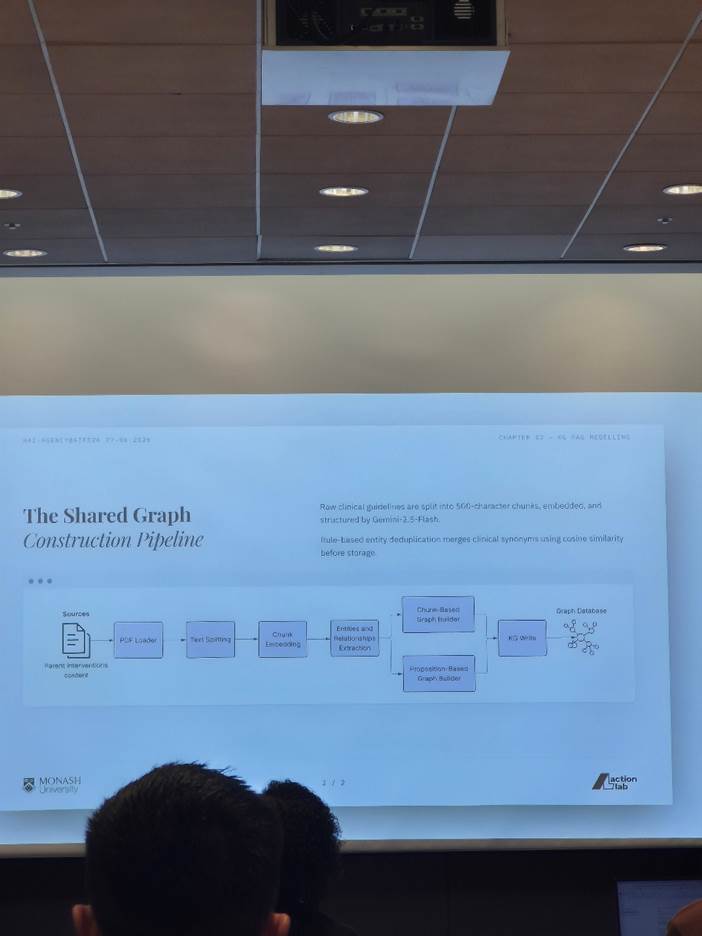
This was a great presentation which illustrated how to construct different knowledge graphs using tools such as Neo4j to address data curation bottlenecks and improve explainability, with the parent of students as the end user in mind. The authors compared the effects of using chunk-based vs proposition-based graphs in their pipeline and evaluated them on characteristics of the representation itself vs qualitative outcomes on users in a workshop. They found that chunk-based representations were better for factual referencing and traceability, while proposition-based were better for generative flexibility and natural dialogues. This gives insight into the trade-offs of different graph representation design choices, as well as informs our future work in using knowledge graphs for steering LLMs and other use cases.
Key Discussions
After my presentation, a researcher from Seoul University asked me why I described our work on the Jill Watson dashboard as co-agency. The underlying question was how was AI actually supporting the teacher’s agency, rather than automating their work.
I view Jill Watson as having the agency to support students of online classrooms in real-time, 1-on-1 conversations, especially handling common questions which does not require much critical thinking on either the student or the teacher’s end. The Jill Watson dashboard supports the teacher’s agency by escalating student needs that Jill Watson can’t resolve along with the context of the student’s interaction, like what they tried up to that point, so that teachers can focus on personalized instructional support for these cases that need the teacher’s expertise. Without a teacher-facing learner model like the Jill Watson dashboard, the teacher would not have this conversational history in online classrooms, and students would not have their needs addressed by the teacher if Jill Watson could not provide a solution.
Day 2: CSEDM Workshop @ EDM’26
This workshop was about educational data mining in CS. It was more focused on technical aspects and system details. I found it to be a great learning opportunity as I would rate myself stronger on the learning science and theory side of things rather than the technical. One recurring pattern was that while the technical contributions were impressive, most of the authors had plenty of student data, all the way down to code-level attempts on CS assignments in introductory programming courses. This is a bit different from our case when working with free-response text in higher-level courses, and at times, anonymous data. It did give clarity on what we would do, if we either had that data, or could curate the data we had into a form we could plug-and-chug.
Notable presentations
SHARP: Socratic Hinting for AI-Reinforced Programming in Competitive Programming Education.
Authors: Yuchen Wang, Chiraag Singh Anand and Chee Wei Tan
Code: https://github.com/Snail664/coding-tutor
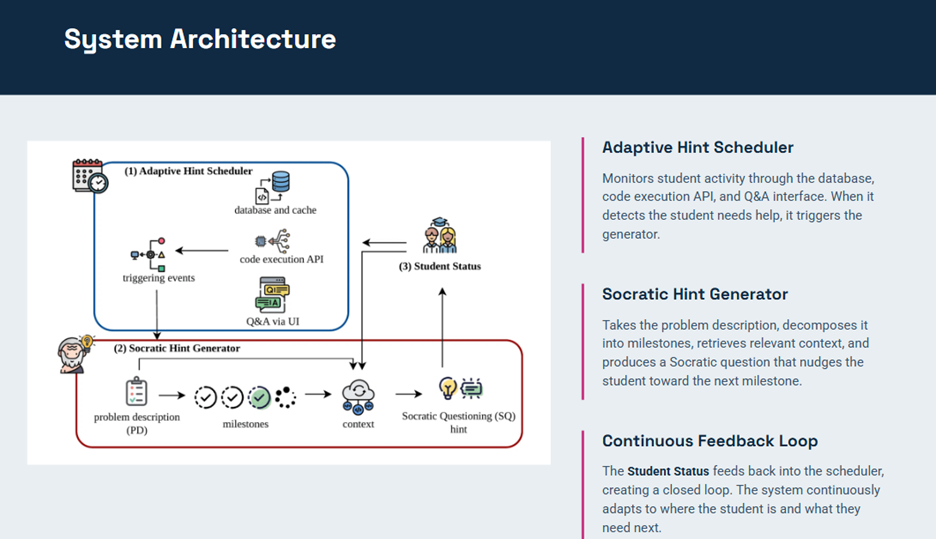
This was a very relevant work as they demonstrated how to apply an LLM-based recommender system-like pattern in a classroom setting. The 3 components were: Socratic hint generation, hint scheduling, and student progress tracker in a continuous feedback loop. The most valuable component was the milestone division using language model embeddings, and student progress inference using semantic similarity, something very similar to our own work on detecting student needs and knowledge gaps. Another takeaway was what intervention the system should generate, which was in this case was Socratic hints.
Operationalizing Misconception Catalogs for LLM Distractor Generation in Introductory Python
Authors: Bryan Hollingsworth, Peter Brusilovsky, Jaromir Savelka
Automated Recommendation of Programming Learning Content Using Pattern-based Knowledge Components
Authors: Muntasir Hoq, Griffin Pitts, Zhangqi Duan, Arun Balajiee Lekshmi Narayanan, Mohammad Hassany, Andrew Lan, Peter Brusilovsky and Bita Akram
Ontology-Guided Knowledge Component Extraction for Programming Exercises
Authors: Rully Agus Hendrawan, Shravya Suresh, Rafaella Sampaio de Alencar, Alice Micheli, Peter Brusilovsky and Sergey Sosnovsky
The takeaway from the 3 papers above was how AIED systems could intervene in response to student needs, and how we can measure learning effects. Knowledge components seems to be a useful intermediary representation, while distractors to identify student misconceptions was an interesting use case that, frankly, I heard about for the first time.
Key Discussions
Upon presenting our work on the knowledge gap detection using pre-requisite graphs, I received plenty of questions and feedback.
Some takeaways:
- Future work on automating pre-requisite graph from course textbook and syllabus can be done with tools such as neo4j, we actually do have a “ground truth”, which are syllabi that teachers produce based on the textbook.
- How do we identify the “depth” of the student’s knowledge gap? As we are now in a graph representation world, an idea is that we can just apply graph algorithms and walk up the tree to identify root causes.
I had a fruitful discussion with another researcher who was working on a similar problem, but perhaps more difficult, for 4 years. They were trying to create concept maps from teacher artifacts such as powerpoint presentations, and they mentioned that this is far more complicated than when we were provided a textbook with a structured table of contents, etc. As presentation slides can be a mix of text, images, and even different structures like tables, formulas, and teachers may not design a course in a linear sequence. While we brainstormed some ideas, this remains future work, as I face a similar problem in analyzing student assignment submissions in KBAI. Hopefully I can solve it in less than 4 years!
Day 3: AIED @ Festival of Learning
I presented our work on evaluating learner representations prior to deployment. I was happy that our work seemed relatively novel compared to what I had seen, as our contribution was before learning effects and focused on studying representations before modelling and direct outcomes. Some sharp questions I had received were how we constructed the learner representations, defined engagement, and how our metric distinctiveness could be applied to other courses such as math.
The core pedagogical features in our representation were validated with classroom data from the same course but with a prior cohort, and our learner representations are an aggregate of models specializing in 1 specific pedagogical features, such as logistic regression, trained to predict engagement risk. Engagement was defined as later participation (frequency of their questions), and yes, distinctiveness can be applied to other courses as it is derived from pairwise comparisons of their interactions with Jill Watson, with no prior assumptions on distance, but “scales” based on the student’s engagement relative to their peers. I guess the next step really is to see if that hypothesis is true, and test it on another class!
Notable presentations
From Feasibility to Generalization in the Field: Using an MR-Based Teacher Orchestration Tool in AI-Supported K-12 Classrooms
Authors: Qiao Jin, Yang Zhan, Will Morgus, Kyle Price, Michael Sandbothe, Jonathan Sewall, Octav Popescu, Susan Berman, Stephen E Fancsali, Steve Ritter, Ken Holstein, Vincent Aleven
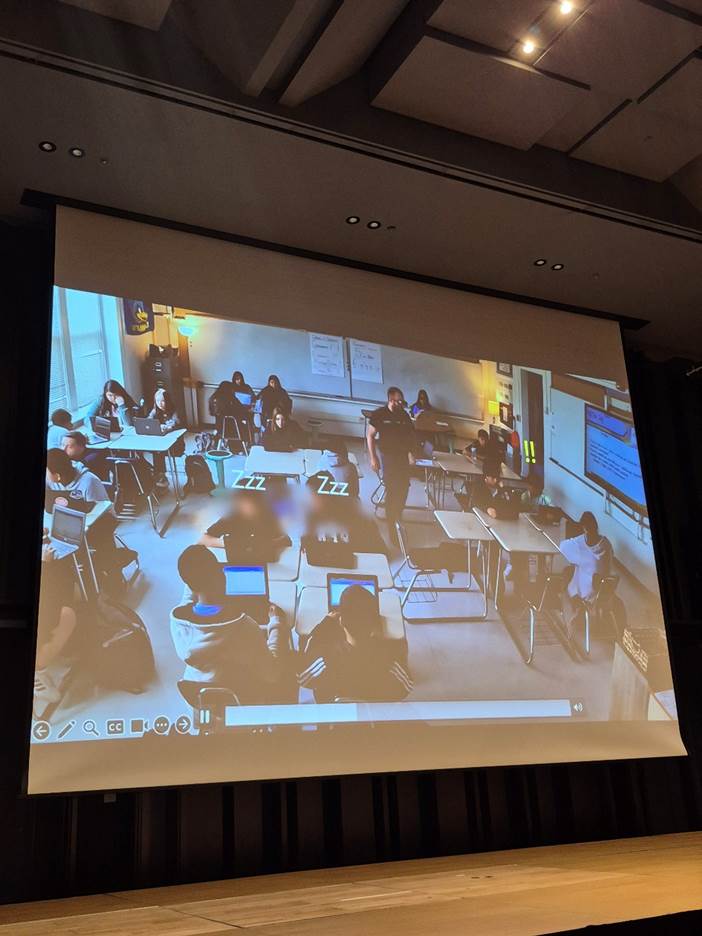
This was an exciting presentation from CMU, with co-authors Ken Holstein and Vincent Aleven, who I have cited in the past. Basically, they have an intelligent teaching system called Mathia, and they have connected it with mixed reality glasses (X-Real), and it indicates in real-time, in augmented reality, student status, such as doing well, unproductively struggling, struggling, and idling. It demonstrated how the systems we develop can be extended to hardware so that teachers can use them in their day-to-day work. I can see how with a little engineering, the tools we build could live in the classroom and beyond in the products that we are already familiar with. Seeing the demo made me intuitively grasp how close we are to that point.
Beyond One-Size-Fits-All: Personalizing Computational Proxies of the Zone of Proximal Development Through Help-Seeking Behaviors
Authors: Kaimao Sheng and Irene-Angelica Chounta
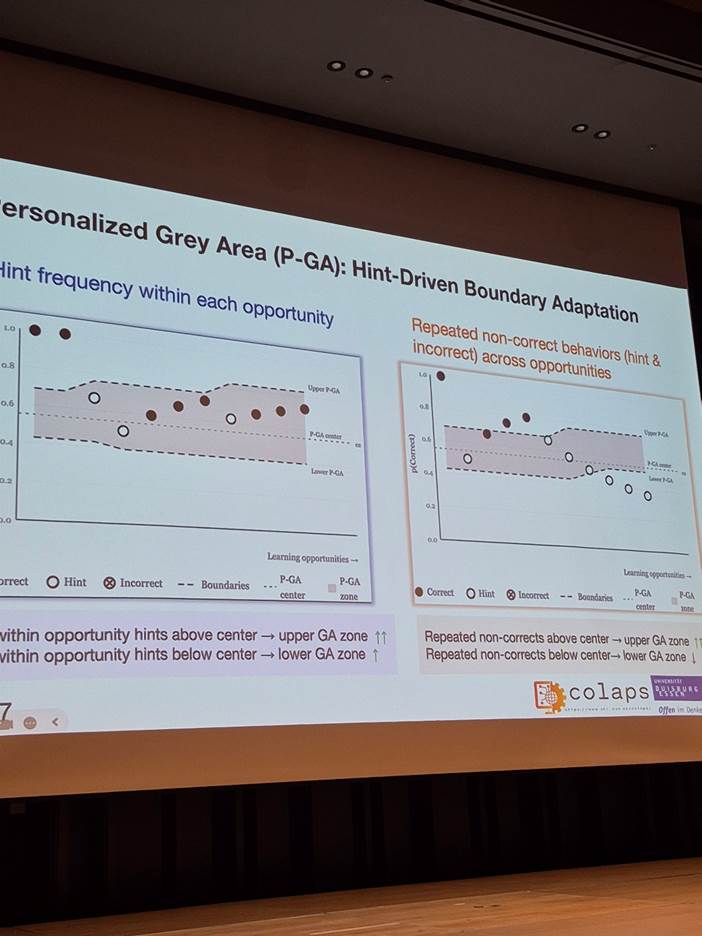
I loved this presentation because it demonstrated an alternate trajectory I could have had at DILab. In my first semester, I was obsessed with Vygotsky’s Zone of Proximal Development, but eventually pivoted my research focus. This demonstration was exactly the implementation of ZPD, my initial obsession. I.e. the authors used a public dataset (DataShop) and modeled it in such a way that the ZPD could be visualized to teachers (and we could use those boundaries to adapt instructional interventions). The dataset comes with it learning outcomes such as hint-correct, hint-hint, and hint-incorrect sequences based on how students behaved in response to 1st hint opportunities in quiz attempts. This gives us a way to study the effect that hints have on learners and when to best provide hints. However, I see the limitation which is that it depends on these labels to be provided in advance. In our setting, had I continued on this path, I probably would have ran into the wall of having no labels for the real classroom data we have, and would have had to use a public dataset. Coming back to Vygotsky though, I’m interested in seeing how we can use it for studying intervention pacing effectiveness using the tools we’ve made such as distinctiveness and our twin network-based classroom simulator pipeline.
Key Discussions
I had the chance to discuss with Vincent Aleven later in the conference and I did ask about the Mixed Reality work. Sorry to be a downer, but I asked, what if the student was shown as idling, when they were actually just thinking? Vincent was aware of these limitations, and said that they did find that students who spent more time reading and understanding the problem actually did better, so the accuracy (is that the right word here?) remains future work.
Day 4: L@S @ Festival of Learning
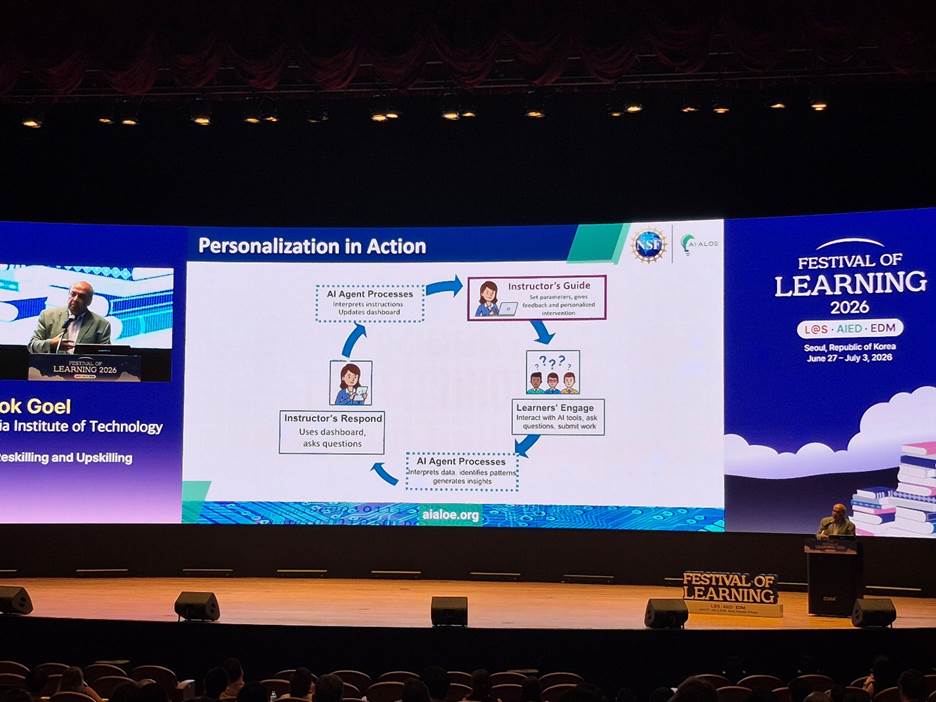
Ashok’s presentation was very well received. I was able to see him at work and in-person for the first time. I could see why he has had such an impact on the field. A great and inspiring experience that I’d recommend to anyone. He had the audience’s complete attention, and people were lining up to talk to him afterwards. What impresses me is how long he has stuck with this, long before everyone knew about ChatGPT.
Notable presentations
Developing Models of Procedural Skills using an AI-assisted Text-to-Model Approach
Authors: Rahul Dass, Shubham Puri, Arpit Khandelwal, Xiao Jin, Ashok Goel
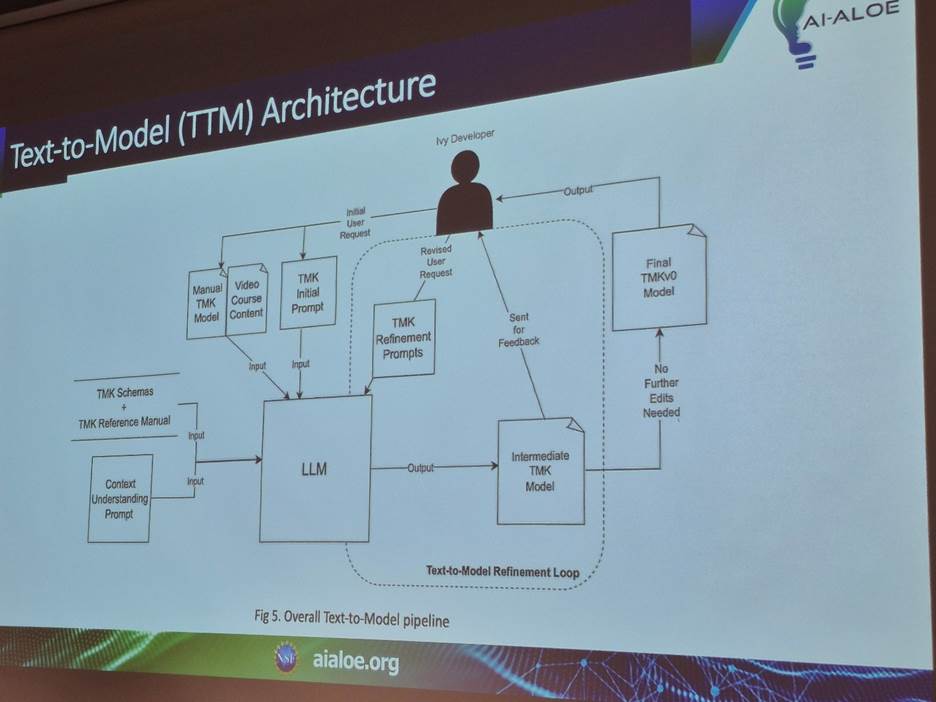
As DILab works on quite a few projects, quite frankly, I didn’t know what TMK was until Rahul’s explanation. There’s a lot of details on how it is actually produced, but my takeaway is that it is an abstraction for turning data into a representation (for procedural skills) which can be used more effectively in downstream modelling. On the job, I use coding agents daily, and the way I view TMK now is that it’s an “agent skill” for DILab’s educational AI tools. An agent skill is really just a prompt with some embedded knowledge representation which is reusable, so I think this is the right analogy. I wonder if TMK representation can be (or if others in the lab are already) encoded directly as a graph using Neo4j and similar tools. I think Text-to-Model is an interesting area to explore, or even Text-to-Representation (representation learning). Future work for sure.
Multistage Modeling from Application Signals to Downstream Success: Predicting Admission, Matriculation, and Retention
Author: David Joyner, Alex Duncan
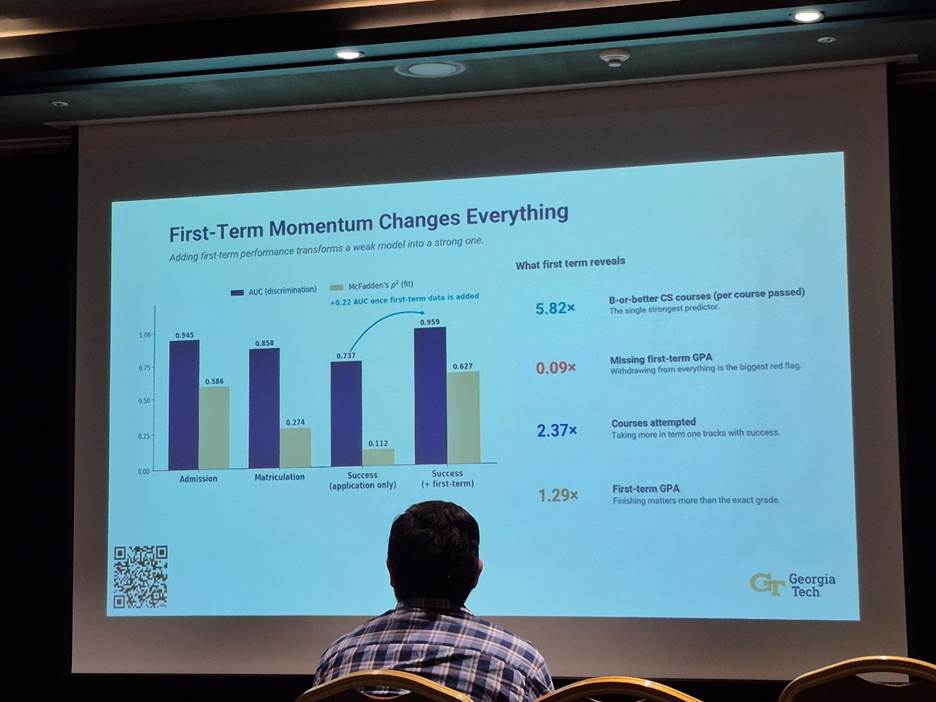
David Joyner’s presentation was the first presentation I saw at the conference that showed the findings from a large sample size. They took 50000 records of OMSCS of applicant demographics as well as text features from their applications and investigated if program success could be predicted at admission time, and with 1st term progress. The takeaway is that success can’t be predicted from the admission, but 1st term momentum makes long-term success in the program explainable. In our work, we do something similar but within a classroom, but I wonder if we can investigate more detailed reports or recommendations at key decision times like at each quarter of the semester.
I asked David about how trajectories differed within specializations, as I guessed that specializations which included Graduate Algorithms would look much different between matriculation and graduation than the specializations that did not. Their study didn’t include graduation data, but he mentioned that they noticed interesting shifts in the population when the interactive computing specialization was renamed to the AI specialization, where those that might have performed poorly in a GA-based specialization shifted to the AI specialization. My view on distribution statistics is that measures might not fully explain an individual’s experience, while group behavior might be more predictable than an individual might expect within their individual experience.
Day 5: Sponsor Panel @ Festival of Learning
On Wednesday, July 1st, I attended the Sponsor Panel and had discussions with Google researchers.
Notable presentations
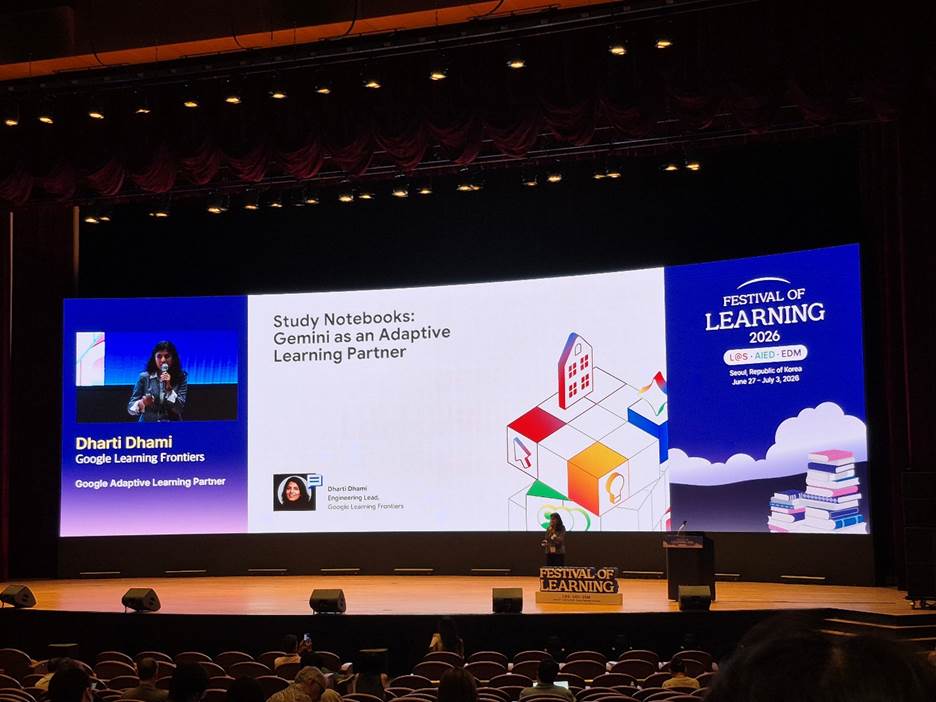
I attended the sponsor talks from Google Deepmind and Google Brain, where they presented their work on Gemini’s guided learning and study notebooks. The way I saw it was that they were solving a very similar problem to Jill Watson and the Jill Watson Dashboard. I was a bit surprised that Google Brain was using the same terminology (meso-learning) from AI-ALOE. I’ve actually used Google’s NotebookLM for studying and I think it’s pretty impressive, especially in its retrieval, although I think its quiz generation is lacking. I was able to have a discussion with the presenters, and here were the key questions:
Q: In their work, what is currently missing that they really want someone to solve?
A: Representations of pedagogical intent.
Q: In their work in meso-learning, what do they find to be the most important thing when doing memory design in AI systems?
A: Starting from the teacher’s theory of change, from there you can design a memory architecture suited for that theory of change.
Key Discussions
I had a good discussion with David Nahodyl, another student at Georgia Tech who works with Dr. Thad Starner. It was interesting to hear how they were using their NOSI IDE in the AI class, and we discussed what they looked for in student interactions in the IDE. We thought breakpoints would be an interesting thing to measure, and also thought it would be really cool to put one of DI Lab’s AI agents inside NOSI, kind of like a Copilot in IDEs nowadays.
We also discussed CS education. I think a challenge currently is that CS undergraduate education does not train students to become a software engineer or get a job in industry. I don’t know if it ever did, and of course, not everyone studies CS to become an engineer. However, if you are going to school in CS to be a software engineer, and schools don’t let you use AI, you will be competing against new grads who do know how to use AI. Industry doesn’t really care if you understand CS theories deeply, they optimize for and reward efficiency. Using AI is highly efficient most of the time. The times it’s not is when AI can’t solve a problem. Here’s a conundrum… If you want to be a software engineer in today’s world, you need to not only be able to use AI for tasks it can do well, but you need to be better than AI, so you can solve the problems it can’t. If the goal is software engineering, how can you start from not knowing how to code, to becoming better at coding than AI in 4 years?
Of course, there’s more to software engineering, and new grads can become good at writing and being able to explain simple, clean code that gets merged, but my questions are now:
- Is the skill of AI literacy/utilization a better skill to optimize for than coding from scratch?
- Aren’t they both forms of problem solving, but at different levels of abstraction?
- If schools don’t teach students how to use AI to solve problems and ban them outright, how much are they setting the students back, or is that actually better for student success after graduation?
Day 6: AIED @ Festival of Learning
I attended Vincent Aleven’s keynote at AIED, as well as the L@S conference for Rahul and David Joyner’s presentations.
Notable presentations
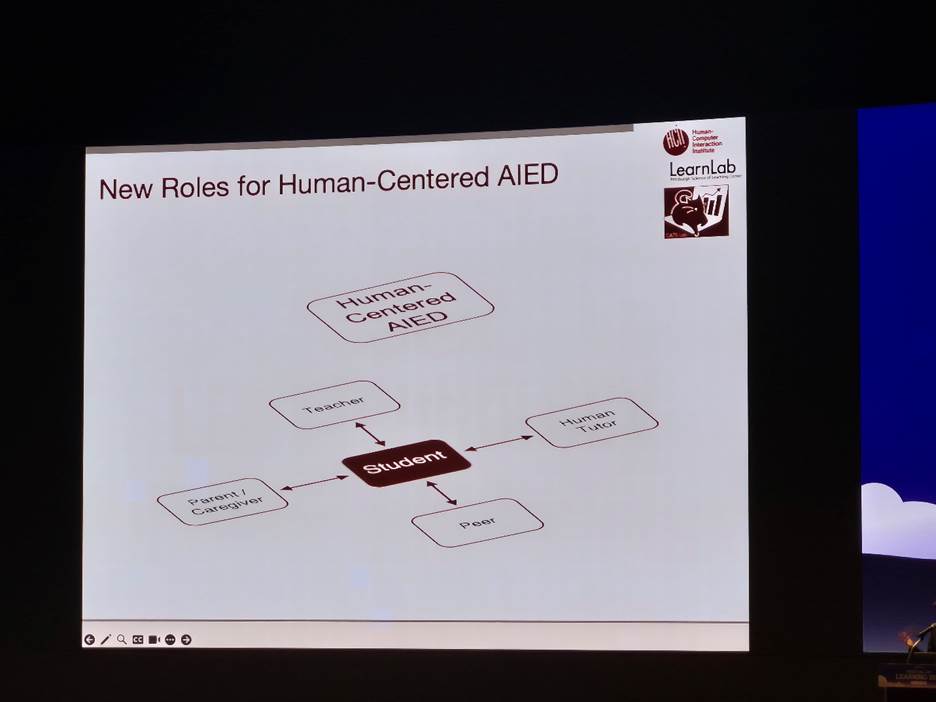
I enjoyed Vincent Aleven’s keynote presentation on human-centered AIED frameworks. Something that didn’t even occur to me before as we work in adult learning, is that parents are a key stakeholder in the student’s learning ecosystem. If we consider a workplace setting, it makes sense, the “parent” might be your manager. In higher education, this role is not so clear. Maybe it’s a more philosophical question, but does this role exist for students in higher ed? Are adult learners performing dual roles in this case, and by improving the student’s caregiver in this case, are we actually improving the part of them that will determine their future success?
Key Discussions
There was a part of the presentation which explained how there was a drop in grades after the rise in AI (I can’t remember the details of where this study took place). It made me wonder if it was AI that was at fault, or if it was that teachers were just grading more harshly. Grades are after all something that the teacher assigns, even if it is rubric based. A question I have is if schools are evaluating the right skills at all for an AI-augmented workforce, and if schools have ever evaluated the right skills for long-term student success.
Day 7: AIED @ Festival of Learning
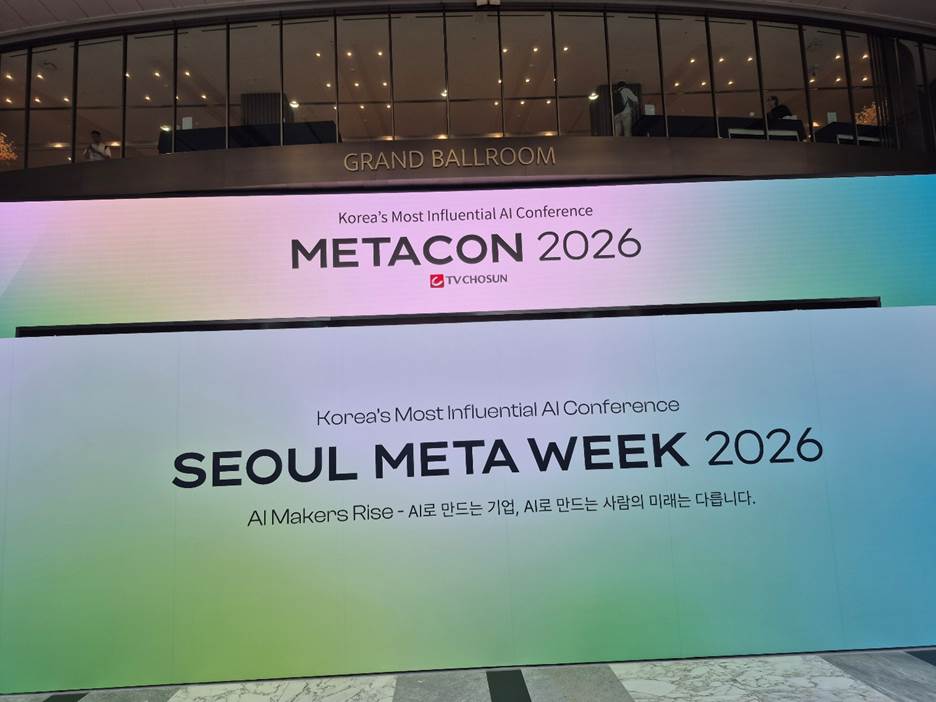
I had the chance to check out another conference at the same venue on the last day, which was more startup focused. It was fun to see how others were using AI in products that addressed peoples’ problems outside of education, even those that were not inconveniences, but ones you might still pay to be addressed. It reminded me that it might be the startups or big companies that actually bring the work that we do to the everyday person, but also, it’s important to not always take things too seriously, and also work on some things purely for your own enjoyment, meaningless as they might be. You never know where you might get inspiration.
Papers to Read
The top 8 papers I want to read next from the conference:
Time as a geometric property of the latent space: An empirical study of Time-and-Order RoPE in Knowledge Tracing
Authors: Willian Costa, Filipe Dwan Pereira, Gabriel Alves, André Nascimento, Luiz Rodrigues, Mario A. P. Santos, Tyagi M. Lima, Rafael Ferreira Mello
Federated Code-Aware Knowledge Tracing for Privacy-Preserving Student Performance Forecasting
Authors: Anurata Prabha Hridi, Muntasir Hoq, Seyyedali Hosseinalipour, Rajeev Sahay, Bita Akram
Measuring Creativity at Scale via Multimodal Large Language Models
Authors: Armanda Lewis and Xavier Ochoa
Misconception Diagnosis From Student-Tutor Dialogue: Generate, Retrieve, Rerank
Authors: Joshua Mitton, Prarthana Bhattacharyya, Digory Smith, S. Thomas Christie, Ralph Abboud and Simon Woodhead
Estimating Learners’ Skill Acquisition Without Temporal Information
Authors: Ryosuke Nagai, Kyohei Atarashi, Koh Takeuchi, Jill-Jênn Vie, Hisashi Kashima
Fair When Sparse, Accurate When Rich: RL-Gated Conversational Fusion for Temporally Equitable Knowledge Tracing
Authors: Fan Zhang, Rui Guo, Hai Li
Spatiotemporal Link Formation Prediction in Social Learning Networks Using Graph Neural Networks
Authors: Ali Mohammadiasl, Bita Akram, Seyyedali Hosseinalipour, Rajeev Sahay
Permutation-Based Significance Testing for Temporal Sequential Patterns in Learning Event Logs
Authors: Tianwei Peng, Jinwang Song, Sijing Yu, Sijie Zhang and Yingbin Zhang
Personal Reflection
One of my biggest takeaways from the conference was that presenting the papers was only the beginning. The real work came after: asking questions, discussing ideas, learning from other researchers, receiving feedback, and building new connections. I feel like I finally got a taste of what it means to do research. It’s also worth acknowledging that I wouldn’t have been at this conference without Georgia Tech’s OMSCS program.
Many thanks to Dr. Ashok Goel for his continued guidance and support throughout this journey. Acknowledgements to the team which I represented: Htet Phyo Wai, Youssef Medhat, Ploy Thajchayapong.
Papers presented:
Park, J., Medhat, Y., Wai, H.P., Thajchayapong, P., Goel, A.K. (2027). Evaluating Learner Representations for Differentiation Prior to Instructional Outcomes. In: Blanchard, E.G., Chen, G., Chi, M., Isotani, S. (eds) Artificial Intelligence in Education. AIED 2026. Lecture Notes in Computer Science(), vol 16585. Springer, Cham. https://doi.org/10.1007/978-3-032-29770-9_4.
Medhat, Y., Park, J., Thajchayapong, P. and Goel, A.K., 2026. Detecting Knowledge Gaps from Conversational AI Interactions Using Curriculum Prerequisite Graphs. arXiv preprint arXiv:2606.10736.
Park, J., Medhat, Y., Wai, H.P., Thajchayapong, P. and Goel, A.K., 2026. Surfacing Isolated Learners with Outcome-Independent Mediation of Feedback between Teachers and Students Using AI. arXiv preprint arXiv:2605.29240.