Congratulations to Vrinda Nandan, Spencer Rugaber, and Ashok Goel for the publication of their chapter, “Explanation as Question Answering based on User Guides”, in Explainable Agency in Artificial Intelligence: Research and Practice.
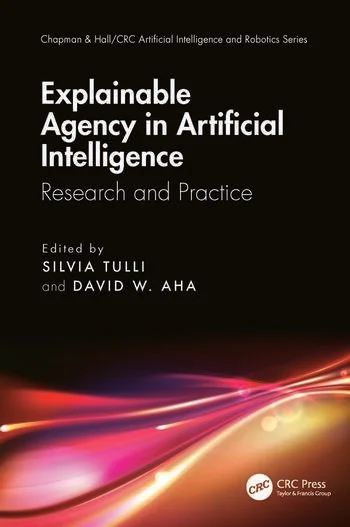
This book focuses on a subtopic of explainable AI (XAI) called explainable agency (EA), which involves producing records of decisions made during an agent’s reasoning, summarizing its behavior in human-accessible terms, and providing answers to questions about specific choices and the reasons for them. We distinguish explainable agency from interpretable machine learning (IML), another branch of XAI that focuses on providing insight (typically, for an ML expert) concerning a learned model and its decisions. In contrast, explainable agency typically involves a broader set of AI-enabled techniques, systems, and stakeholders (e.g., end users), where the explanations provided by EA agents are best evaluated in the context of human subject studies.
The chapters of this book explore the concept of endowing intelligent agents with explainable agency, which is crucial for agents to be trusted by humans in critical domains such as finance, self-driving vehicles, and military operations. This book presents the work of researchers from a variety of perspectives and describes challenges, recent research results, lessons learned from applications, and recommendations for future research directions in EA. The historical perspectives of explainable agency and the importance of interactivity in explainable systems are also discussed. Ultimately, this book aims to contribute to the successful partnership between humans and AI systems.